

Keep showing up! Lessons beyond running by Subhjit Sarkar

Introduction
Today, I'm joined by someone who was one of my earliest guests when I had just started Run Chronicles three years ago.
Back then, we were both preparing for our first World Marathon Major, Berlin. Since then, our paths have crossed in the most unexpected ways.
Funnily enough, we've still never met in India, but we did catch up in Paris after Berlin. A lot has changed since our first conversation. There has been growth, new experiences, new challenges, and plenty of valuable lessons along the way. So, we thought this would be the perfect time to reconnect.
Joining me today is Shubhjit Sarkar, someone who truly embodies the phrase, keep showing up. Whether it's showing up for his runs, delivering talks on AI, mentoring others, or balancing a demanding career in technology, he does it all with remarkable consistency.
What many people may not know is that he also navigates several health challenges. Yet, no matter what life throws at him, he continues to show up, not just for himself, but for his mentees, his work, and the running community.
I believe there's a lot we can all learn from that.
So, without further ado, let's begin our conversation.

It has been three years since our first conversation. How has the journey evolved since Berlin?
It has been a really interesting journey for both of us. Since Berlin, I have completed four more World Marathon Majors, and I believe you have completed three more.
In 2023, I also completed my ACSM Marathon Sports Certification, which opened up a completely new direction for me as a marathon coach. Last year, I went on to complete the Procam Slam as well.
Looking back, what stands out the most is that learning never really stops. Every training cycle teaches you something new. Every race leaves you with a lesson that stays with you.
Over the last three years, the World Marathon Majors have taught me so much about training, preparation, recovery, and racing in different conditions. What excites me most now is not keeping those lessons to myself, but sharing them with the runners I coach and with the running community at large.
You completed the Procam Slam last year. Tell us a little about that journey.
The Procam Slam is about completing four major races across Mumbai, Bengaluru, Delhi, and Kolkata. You can run them in any order, but those four races make up the circuit.
I had wanted to complete it for a long time, but balancing work with race dates was never easy.
When I was preparing for New York and Boston, I realised it was the perfect training cycle to include the Procam Slam as well. Fortunately, work did not interfere with my plans, and I was able to complete it in my eleventh year of running.
I'm really glad I did because every race offers a completely different experience.
Tata Mumbai is a full marathon, Vedanta Delhi is a half marathon, Tata Steel Kolkata is a 25K, and Bengaluru is a 10K. Every city has its own weather, roads, race culture, and running community. Experiencing those differences is what makes the Procam Slam so special.

Has your approach to running changed over the years?
Absolutely.
One thing has become very clear to me with every passing year. The body changes, and so do our priorities.
As runners, we know that VO2 max changes with every decade, and I can clearly feel that my body isn't as agile as it once was. Because of that, one conscious decision I made after 2023 was to become much more selective about the races I run.
I no longer participate in as many local events as I used to. Instead, I choose races that truly matter to me.
The same philosophy extends to my coaching.
Most of my coaching is on a pro bono basis because I have a full-time career. One of the first things I tell every runner is to be selective. Running has become highly commercialised, and there seems to be a race every Sunday. It is important to choose events thoughtfully rather than trying to run everything.
Another major learning has been understanding how my body has evolved. Learning about recovery, the right supplements, and balancing strength training with running has become just as important as the kilometres I run.
Those lessons have helped me far more today than they did a few years ago.
Has there been a coaching experience that particularly stayed with you?
One of my trainees came to me last year with a very clear goal. She wanted to complete the Procam Slam, and it was only her third year of running.
Instead of jumping straight into race preparation, I wanted her to build a strong foundation first.
For almost a year, our focus was simple. Slow and easy runs. Building aerobic fitness, maintaining the right heart rate, eating well, sleeping well, and allowing the body to adapt gradually.
Only after we were confident that she had built a strong base did she begin her Procam Slam journey.
The results were incredibly satisfying. She completed her first full marathon in under five hours and finished all four races injury-free.
That experience reinforced one of my strongest beliefs as a coach.
You don't have to rush to achieve big results.
If you're patient enough to build a strong foundation and trust the process, the results will eventually follow.
You've experienced almost every World Marathon Major now. Which one has been the most memorable?
Honestly, every World Major has been memorable in its own way.

London began at around six degrees, but between the 25 and 35 kilometre mark it started raining. By the finish, my entire running gear was completely soaked.
Tokyo was another unforgettable experience. The race started in temperatures between six and ten degrees, but by the second half it had climbed to almost twenty-two degrees. It was a dramatic temperature change, and to make it even more memorable, it had snowed that night.
New York is unlike anything else. Running through five boroughs, crossing five bridges, and tackling its iconic elevation makes it one of the most unique marathon experiences in the world.
Berlin is the complete opposite. It is the flattest of all the World Marathon Majors and offers an entirely different racing experience.
Boston has its own personality. The climbs begin just when you least want them to, during the second half of the race. We even experienced a hailstorm, and breathing in the cold air added another layer of challenge.
Every World Major teaches you something different, and that is what makes each one so memorable.

One thing I have realised over the years is that changing weather patterns are making these races progressively more challenging. For Indian runners especially, preparing through our summer conditions and then adapting to completely different race day weather requires both physical and mental preparation.
There is also one misconception I would like to address.
Many people believe that once you make it to the start line, the medal is almost guaranteed.
That simply isn't true.
Whether you qualify through time or earn your place through the charity route, both paths are equally valid. But from the start line onwards, everyone has to complete the same 42.2 kilometres within the official cut-off time.
The medal has to be earned.
For anyone planning their first World Major, my advice is simple. Train well, prepare for the conditions, and work just as much on your mental strength as your physical fitness.
You shared a lovely video of you just before the finish line, from the London Marathon. Do you often take videos while running?
Honestly, it's never planned.

I simply capture those moments whenever they feel special.
In Tokyo, I recorded a short video near Sensoji Temple. In London, it was while running past Big Ben.
Those moments are impossible to recreate.
When you're about to finish something that thousands of runners dream about, and you're moments away from receiving a medal that means so much, you naturally want to preserve that feeling.
I remember thinking the same during Boston. So many elite runners couldn't make it because of visa issues, conflicts around the world, or circumstances beyond their control. Yet, I was fortunate enough to be there.
Those videos are not really for social media. They're memories.
Whenever I watch them again, they take me back to exactly how I felt in that moment.
At one point, you consciously stepped away from the pressure of chasing timings. What led to that decision?
Before 2023, I was part of a few running groups, and there are certainly many positives to being part of a community. You get guidance, encouragement, company, and you learn a great deal from fellow runners.
But there is another side to it as well.
There is often an unspoken pressure to compare yourself with others. You see runners finishing in sub-4, sub-5, or sub-6 hours, and without even realising it, you begin measuring your progress against theirs. You either feel left behind or constantly feel the need to catch up.
At some point, I realised that wasn't the kind of relationship I wanted with running. Hence, I made a conscious decision to step away from that environment and start running on my own.
It turned out to be one of the best decisions I have made.
I could finally listen to my own body instead of someone else's pace. I could decide what felt comfortable, understand what my body was ready for, and choose races that aligned with my own goals rather than external expectations.
That approach has helped me enjoy running more and focus on longevity rather than constantly chasing timings.
How do you see the running culture evolving today?
The running culture has changed tremendously over the years, and I am sure it is the same in Pune as it is in Mumbai.
Most of my runs happen in South Mumbai, and these days I come across several influencer-led running groups where I hardly recognise any faces.
In many ways, I think that is a wonderful sign. If these communities are encouraging people to get out of bed on a Sunday morning and start running, that is a positive for the sport.
At the same time, I also feel there is another side to it.
For many, the motivation seems to be content creation rather than building a long-term relationship with running.
I hope more people stay with the sport beyond social media trends and discover the joy of running simply because they enjoy it.
Are there any running communities that have particularly influenced your journey?
Absolutely.
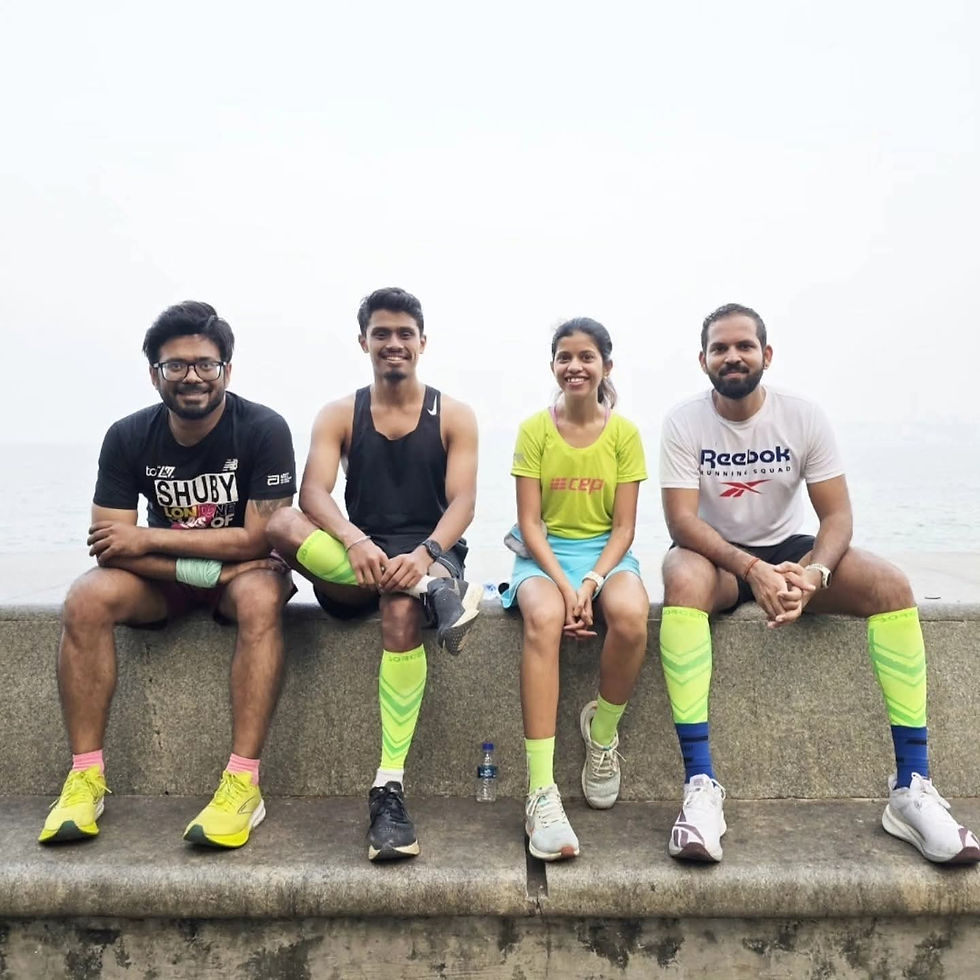
I have been associated with Mumbai Roadrunners for the past eleven years, and it continues to be one of the communities I value the most.
What I appreciate about Mumbai Roadrunners is that their focus has always been on promoting running. Our monthly runs welcome newcomers, encourage runners to learn proper techniques, and create opportunities to learn from each other's experiences.
Today, I think we are nearly fifteen to twenty thousand members strong online, and it is a community I have proudly been part of for over a decade.
Over the last few years, I have also been closely associated with the Comrades Running Group.

What inspires me most about them is their dedication. Preparing for a ninety-kilometre race requires months of disciplined training, and being surrounded by people with that level of commitment is incredibly motivating.
I have not decided whether I will run Comrades myself one day, but I genuinely enjoy being around people who inspire me through their discipline.
Take Satish Gujran Sir, for example. He has completed Comrades fifteen times. That level of consistency and commitment is simply mind-blowing.
Those are the communities I feel most connected to. Beyond that, I also enjoy interacting with friends who now work with brands like Nike, Adidas, and New Balance. It is always interesting to exchange ideas with people who are contributing to the sport in different ways.
You balance a demanding professional career with marathon training. How have you managed that?
After spending almost two decades in the corporate world, I consciously decided in 2024 to move into an institution that combines academics with industry.
Teaching has always been close to my heart. I have been teaching at business schools for the last twelve years, and more recently I began my association with IIT Bombay, where I am in a leadership role.
My work focuses on AI/ML-based product innovation, along with collaborating with startups across India's growing innovation ecosystem.
This transition has helped me create a much healthier balance between work and running.
There are deadlines here as well, but they are not as demanding as they were during my corporate years.
Today, it is about consciously deciding how much time I dedicate to work and how much time I invest in running.
That balance has worked very well for me.
You coach professionals at work and runners on the road. Do you see similarities between the two?
Very much so.
The advice I give to my corporate teams is the same advice I give the runners I coach.
Always think long term.
Do not chase shortcuts, crash diets, or quick fixes. Whether it is your career or your running journey, lasting success comes from consistency. I often tell young professionals, especially Gen Z, not to focus only on the next promotion. Instead, learn the craft. Understand the fundamentals. Build skills that will sustain your career for the next twenty years.
The same philosophy applies to running.
We live in a world of instant gratification where everyone wants results immediately. But meaningful progress takes time.
Whatever your goal may be, getting the basics right will always matter more than finding the next shortcut.
Once you complete Chicago, you'll become a Six Star Finisher. What will that moment mean to you?
Honestly, it will be a very emotional moment because becoming a Six-Star Finisher was never part of my original plan.
I still remember seeing Neeru Bajaj's Six Star Medal around 2018 or 2019. At the time, I remember wondering why someone would travel across the world just to collect six medals.
Then I watched runners like Kranti Salvi gradually complete the journey, and somewhere after the lockdown, that dream quietly became mine too.
To go from never thinking about the Six Star journey to actually completing all six races is something I will need time to absorb.
It is definitely going to be one of the biggest milestones of my running journey.
I have not yet decided how I will celebrate.
After New York and Boston, I spent time exploring the East Coast of the United States. This time, after Chicago, I may head to the West Coast, where I have several friends.
That is another beautiful aspect of running. It allows you to discover new places, cultures, and people.
Running has given me experiences far beyond the finish line.
And while I know running will always remain a part of my life, I also look forward to exploring other sports like cycling and swimming after completing my sixth World Marathon Major.
Finally, what advice would you give to someone who is just beginning their running journey?
Shubhjit:
If there is one piece of advice I would give to newcomers, it is to think long term.
Priorities your goals, listen to your body, and equally importantly, think about your work-life.
I believe many new runners tend to overlook this.
A lot of people begin to derive their sense of validation and identity from running, especially if they are not finding the same fulfilment in their professional lives.
But your career is what will sustain you for the next forty years, not running.
In fact, I met a young runner after one of my long runs recently. He had already won several podium finishes and was doing exceptionally well.
When I asked him about his professional life, he told me he was taking up random gigs, whatever helped him get by.
So I asked him a simple question.
"What is your long-term career plan?"
He didn't have an answer. That conversation stayed with me because I think it reflects a mindset I see quite often today. Many young runners are focused on immediate recognition, content creation, and short-term success without thinking about where they want to be twenty or forty years from now.
A good work environment, healthy competition, continuous learning, and financial stability are all part of personal growth. They help you grow professionally, mentally, emotionally, and as a person.
Running can absolutely be a part of your life, just like music, art, swimming, or any other passion that brings you joy.
But build a career that gives you stability and purpose.
Let your profession and your passion complement each other, not compete.
That would be my advice to anyone starting this journey.
Closing
Indrani:
Thank you, Shubhjit, for sharing your journey and your thoughts so candidly.
What stayed with me throughout this conversation was that, while we spoke about marathons, medals, and World Majors, the bigger message was really about patience, consistency, and showing up every single day.
Whether it is running, coaching, or building a meaningful career, the principles remain the same.
I wish you all the very best as you complete your sixth World Marathon Major in Chicago and continue inspiring runners through your coaching and mentorship.
I'm sure this won't be the last chapter of your journey. In many ways, it feels like the beginning of a new one.
Thank you for being a part of Run Chronicles once again.
Runner - Subhjit Sarkar
Instagram handle - @shubistark


Comments